Perfectionism: When “Doing Your Best” Never Feels Good Enough

Perfectionism Is More Than Wanting to Do Well
Wanting to succeed, having high standards, and caring about the quality of your work aren't necessarily problems. In fact, these qualities can be strengths.
Perfectionism becomes difficult when your expectations leave little room for mistakes, uncertainty, learning, or simply being human.
You may accomplish something and immediately notice what you could have done better. You might spend far more time than necessary preparing for something because you are afraid of being caught off guard. You may struggle to delegate because trusting someone else means giving up control.
And sometimes perfectionism sounds like:
“I should have known better.”
“I can't mess this up.”
“If I'm going to do it, I need to do it right.”
“What if they think I don't know what I'm doing?”
“I should be able to handle this myself.”
At Wonder and Grow Therapy, I provide online therapy for adolescents and adults throughout Florida and Minnesota who struggle with perfectionism, anxiety, overthinking, ADHD, OCD, people-pleasing, and the pressure to always get things right.
What Does Perfectionism Look Like?
Perfectionism isn't always obvious.
You don't have to keep a perfectly organized house or get straight A's to struggle with it. In fact, perfectionism can sometimes look like the exact opposite.
It can look like procrastinating because you don't know where to start.
Avoiding something because you're afraid you won't be good at it.
Rewriting an email five times before sending it.
Replaying a conversation because you're worried you said something wrong.
Feeling uncomfortable accepting a compliment because you immediately think about what you could have done better.
Or becoming overwhelmed by a task because your brain has turned “I need to do this” into “I need to do this perfectly.”
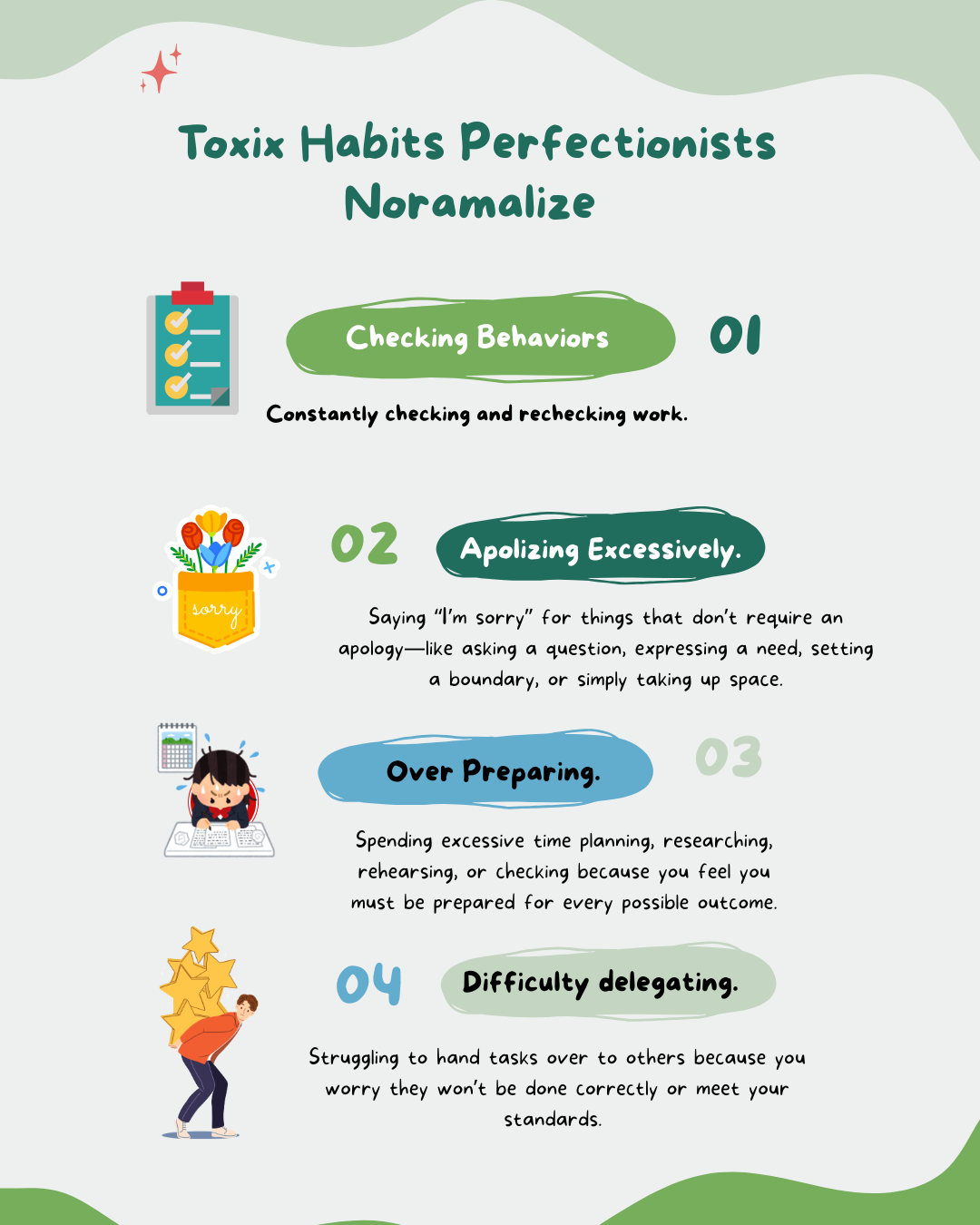
Toxic Habits Perfectionists Can Normalize
Some perfectionistic behaviors become so automatic that you may not even recognize them as perfectionism.
Checking Behaviors
Constantly checking and rechecking your work because it never quite feels safe to trust that you've done enough.
Apologizing Excessively
Saying “I'm sorry” for things that don't require an apology—like asking a question, expressing a need, setting a boundary, or simply taking up space.
Over-Preparing
Spending excessive time planning, researching, rehearsing, or checking because you feel you must be prepared for every possible outcome.
Difficulty Delegating
Struggling to hand tasks over to others because you worry they won't be done correctly or meet your standards.
Do any of these feel familiar?
These behaviors can provide a temporary sense of safety or control. The problem is that they can also reinforce the belief that you have to keep doing them in order to prevent mistakes, criticism, or disappointment.
The Perfectionism Cycle
Perfectionism can create a cycle that looks something like this:
High expectations → Fear of making a mistake → Overthinking or over-preparing → Checking, procrastinating, or avoiding → Temporary relief → Self-criticism → Even higher expectations
For example, imagine you need to send an important email.
You write it.
Then reread it.
Then change a sentence.
Then wonder if it sounds rude.
You read it again.
Maybe you ask someone else what they think.
Eventually, you send it—but instead of feeling finished, you start wondering whether you should have worded something differently.
The problem wasn't that you cared about writing a good email.
The problem was that your brain was searching for something that doesn't exist:
absolute certainty that you couldn't possibly make a mistake.
Perfectionism and Overthinking
Perfectionism and overthinking often feed each other.
When making a mistake feels unacceptable, your brain naturally tries to anticipate every possible problem before it happens.
You may spend hours analyzing decisions because you want to make the “right” choice. You may replay interactions because you want reassurance that you handled them correctly.
But more thinking doesn't always produce more certainty.
Sometimes it just produces more things to think about.
An important part of therapy can be learning to recognize when you're productively problem-solving and when you're caught in a perfectionistic thinking loop.
Perfectionism and People-Pleasing
Perfectionism doesn't only apply to work and achievement. It can show up in relationships too.
You might believe you need to be the perfect friend, partner, parent, employee, or child.
That can mean saying yes when you want to say no, apologizing when you've done nothing wrong, avoiding difficult conversations, worrying excessively about disappointing people, or feeling responsible for how everyone around you feels.
Underneath it may be a belief such as:
“If I do everything right, no one will be upset with me.”
Unfortunately, relationships don't work that way.
You can be thoughtful, compassionate, and considerate and still disappoint someone.
Learning to tolerate that possibility can be an important part of developing healthier boundaries.
The Difference Between Healthy Standards and Perfectionism
Healthy striving allows room for being human.
Healthy striving says:
“I want to do well.”
Perfectionism says:
“I can't make a mistake.”
Healthy striving says:
“I can learn from feedback.”
Perfectionism says:
“Feedback means I wasn't good enough.”
Healthy striving says:
“I'll prepare for this.”
Perfectionism says:
“I need to prepare for every possible thing that could happen.”
Healthy striving says:
“Someone else may do this differently than I would.”
Perfectionism says:
“If I want it done correctly, I have to do it myself.”
The goal of therapy isn't to make you stop caring or lower every standard.
It's learning how to pursue things that matter to you without your self-worth depending on doing them perfectly.
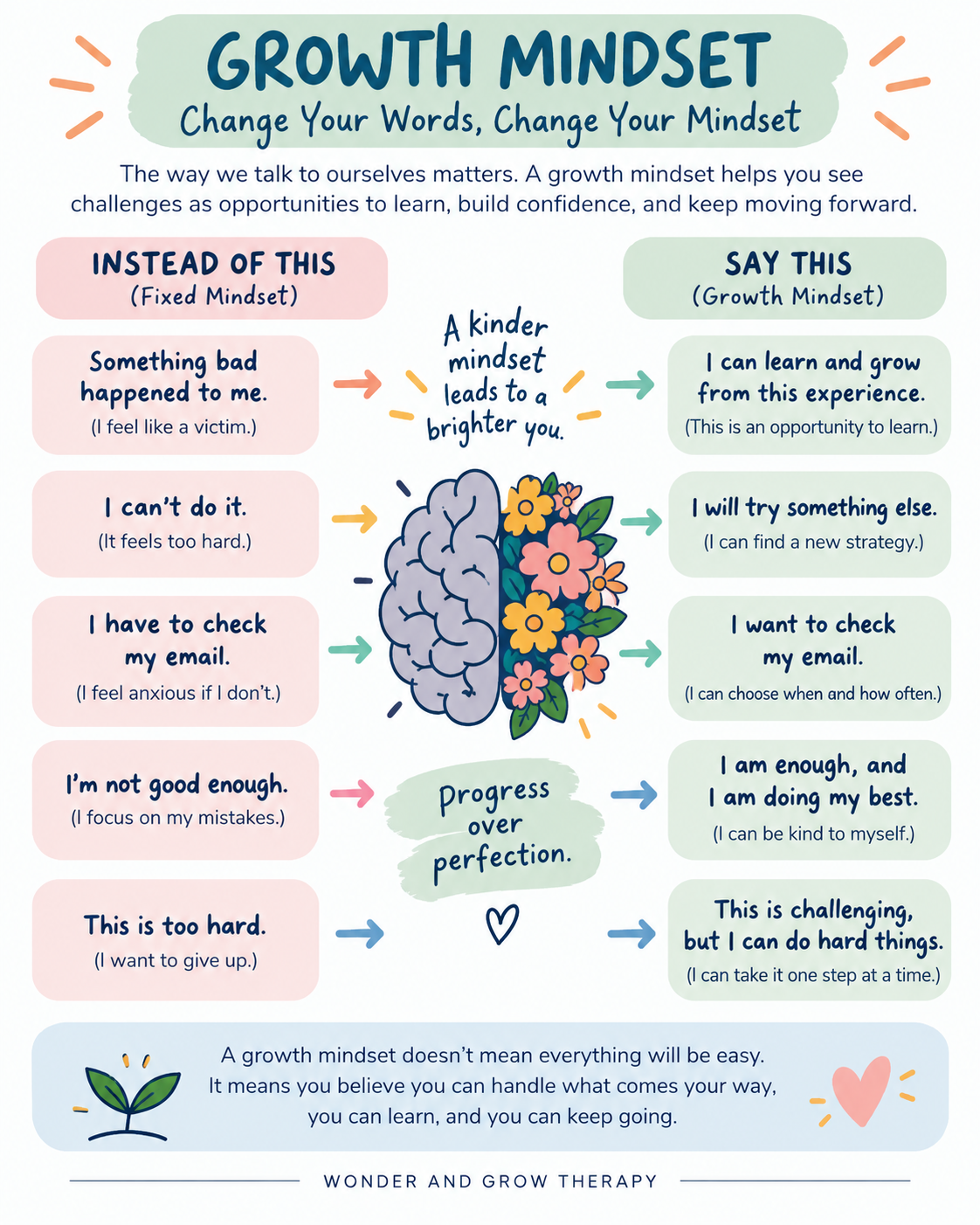
Moving From a Fixed Mindset to a Growth Mindset
Perfectionism often thrives in a fixed mindset.
A mistake becomes evidence:
“I'm bad at this.”
“I failed.”
“Everyone else can handle this except me.”
A growth mindset allows another interpretation:
“I'm learning.”
“I can be uncomfortable and still try.”
“One mistake doesn't erase everything I did well.”
“Not knowing something doesn't mean I'm incapable of learning it.”
“Good enough can actually be good enough.”
This doesn't mean pretending mistakes don't matter.
It means treating mistakes as information rather than identity.
How Therapy Can Help With Perfectionism
In therapy, we can work on understanding what your perfectionism is trying to protect you from.
Maybe it's criticism.
Rejection.
Embarrassment.
Failure.
Disappointing someone.
Feeling out of control.
Or believing you're not good enough.
Depending on your individual needs, I incorporate approaches including Cognitive Behavioral Therapy (CBT), Dialectical Behavior Therapy (DBT), mindfulness, self-compassion, and Exposure and Response Prevention (ERP) when appropriate for OCD.
We may work on identifying cognitive distortions, challenging all-or-nothing thinking, reducing excessive checking and reassurance seeking, tolerating uncertainty, setting boundaries, decreasing people-pleasing, responding differently to mistakes, and building confidence in your ability to handle situations that don't go perfectly.
What If You Didn't Have to Get Everything Right?
Imagine completing something and allowing yourself to be finished.
Sending the email without reading it six more times.
Saying no without writing a paragraph explaining why.
Allowing someone else to complete a task differently than you would.
Trying something new before you're certain you'll be good at it.
Making a mistake without spending the rest of the day criticizing yourself for it.
The goal isn't to stop caring about doing well.
It's developing the flexibility to recognize:
I can care about doing something well without requiring myself to do it perfectly.
You Are Allowed to Be a Work in Progress
You don't need to become less motivated, less thoughtful, or less ambitious.
You can learn to pursue the things that matter to you without constantly measuring your worth against an impossible standard.
Together, we can work on recognizing perfectionistic patterns, challenging the thoughts that keep them going, building greater tolerance for uncertainty and mistakes, and developing a healthier relationship with yourself.
Wonder and Grow Therapy provides online therapy for adolescents and adults throughout Florida and Minnesota.