Therapy for Overthinking & Racing Thoughts:
When Your Brain Just Won’t Turn Off
Does your brain ever feel like it just won’t stop thinking?
You may replay conversations long after they happen, analyze decisions from every possible angle, worry about things that haven’t happened yet, or constantly question whether you said or did the “right” thing.
Maybe you find yourself thinking:
“What if I made the wrong decision?”
“Did I upset them?”
“What if something goes wrong?”
“Why did I say that?”
“What if I can’t handle it?”
Overthinking can feel like problem-solving, but eventually it can leave you feeling anxious, exhausted, stuck, and unable to trust yourself.
At Wonder and Grow Therapy, I provide online therapy for adolescents and adults throughout Florida and Minnesota who struggle with overthinking, racing thoughts, anxiety, ADHD, OCD, perfectionism, and related patterns.
Why Do I Overthink Everything?
Overthinking is often your brain's attempt to create certainty.
If you can analyze the situation enough, prepare for every possible outcome, or figure out exactly what another person is thinking, maybe you can prevent something painful from happening.
Unfortunately, the search for certainty can become its own cycle:
Something happens → You feel anxious → You start analyzing → You temporarily feel more in control → Another doubt appears → You analyze again.
You might replay a conversation to make sure you didn't embarrass yourself. You might ask someone repeatedly if they're upset with you. You may research a decision for hours because you are afraid of making the wrong choice.
The goal isn't to never think about things deeply. It's learning when thinking is helping you and when it has turned into a loop that's keeping you stuck.
Signs Overthinking May Be Affecting You
Overthinking can look different for everyone. You might:
Replay conversations and interactions in your head
Constantly second-guess decisions
Imagine worst-case scenarios
Have difficulty falling asleep because your mind is racing
Seek reassurance from other people
Spend excessive time researching before making decisions
Worry about what other people think of you
Feel responsible for keeping everyone happy
Avoid decisions because you're afraid of making the wrong one
Struggle with perfectionism
Analyze texts, emails, or someone's tone of voice
Have difficulty being present because you're thinking about what already happened or what might happen next
Sometimes overthinking occurs alongside anxiety, ADHD, OCD, perfectionism, low self-confidence, or people-pleasing. Understanding what is driving your overthinking can help determine which strategies are most useful.
A Different Way to Respond to Overthinking
One of the skills I work on with clients is learning to become curious about thoughts instead of automatically believing or fighting them.
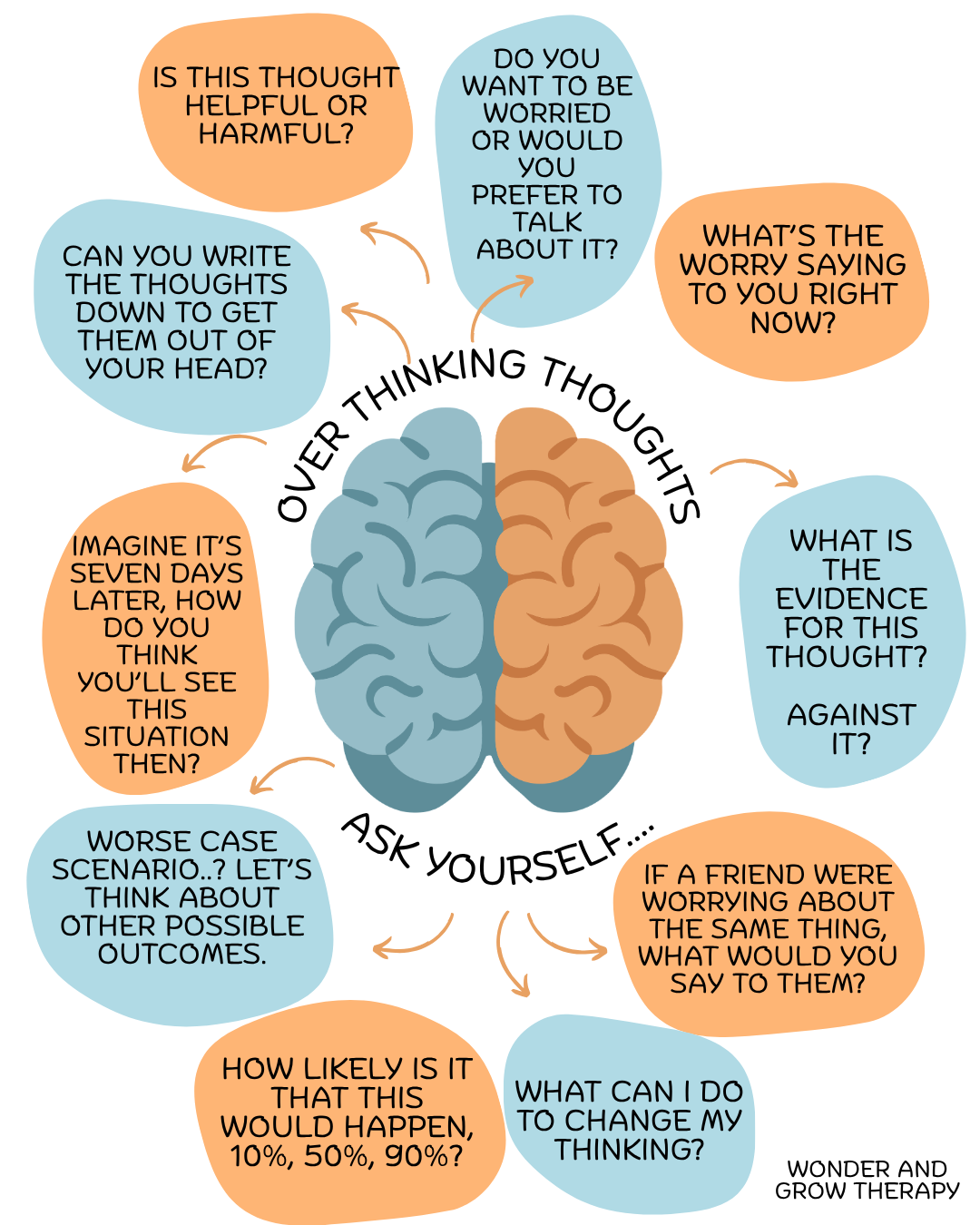
When you notice yourself getting caught in an overthinking spiral, try asking yourself:
Is this thought helpful or harmful?
What is the worry saying to me right now?
What evidence supports this thought? What evidence goes against it?
Am I responding to a fact—or to something I'm afraid might happen?
How likely is the outcome I'm imagining?
What would I say to a friend who was having this same thought?
If I looked back at this situation seven days from now, might I see it differently?
What is actually within my control right now?
These questions aren't about forcing yourself to “think positively.” They help you slow the process down and examine whether your thoughts are accurate, useful, and deserving of your attention.
Overthinking Thoughts: Ask Yourself…
You can save these questions and return to them when you notice yourself getting caught in a thinking loop.
You Don't Have to Solve Every Thought
This is an important part of therapy for overthinking.
Sometimes challenging a thought is helpful.
Other times, continuing to analyze the thought—even therapeutically—can become more overthinking.
That's why we may also work on learning to tolerate uncertainty, allowing uncomfortable thoughts to exist without solving them, redirecting your attention to the present, and recognizing when your brain is asking a question that doesn't actually need an answer.
Instead of:
“How do I make absolutely sure this doesn't happen?”
we might work toward:
“I don't know exactly what will happen, but I trust myself to handle what comes next.”
That shift can be powerful.
How Therapy Can Help With Overthinking
In therapy, we can slow things down and understand what keeps your particular cycle going.
Depending on your needs, I incorporate approaches including Cognitive Behavioral Therapy (CBT), Dialectical Behavior Therapy (DBT), mindfulness, and Exposure and Response Prevention (ERP) when appropriate for OCD.
We may work together on identifying cognitive distortions, separating facts from feelings, decreasing reassurance seeking, challenging perfectionism, tolerating uncertainty, improving emotional regulation, practicing boundaries, reducing people-pleasing, and developing greater confidence in your ability to make decisions without having complete certainty.
The goal isn't to turn off the thoughtful part of your brain.
It's to help you learn how to use your thoughts without letting your thoughts control you.
From Overwhelmed to More Grounded
You don't need to have everything figured out before starting therapy.
If you're exhausted from constantly analyzing, worrying, second-guessing yourself, or trying to prepare for every possible outcome, therapy can give you a place to slow down and understand what's happening.
Together, we can work toward helping you recognize your patterns, respond differently to racing thoughts, build trust in yourself, and make more room for the life happening outside of your head.
Wonder and Grow Therapy provides online therapy for adolescents and adults throughout Florida and Minnesota.
Ready to quiet some of the noise?