Anxiety Therapy:
When Worry Starts Taking Up Too Much Space

Anxiety can make it feel like your mind and body are always preparing for something to go wrong.
You may replay conversations, worry about the future, second-guess decisions, feel responsible for keeping everyone happy, or find yourself thinking through every possible outcome before you can relax.
Sometimes you know you're anxious. Other times, anxiety doesn't feel like worry at all.
It may show up as a headache, upset stomach, muscle tension, irritability, difficulty sleeping, exhaustion, restlessness, or simply feeling like you can never completely let your guard down.
At Wonder and Grow Therapy, I provide online therapy for adolescents and adults throughout Florida and Minnesota who are struggling with anxiety, overthinking, racing thoughts, perfectionism, people-pleasing, and the pressure to keep everything together.
What Does Anxiety Feel Like?
Anxiety is more than feeling nervous.
Your brain has a built-in alarm system designed to recognize potential danger and help your body respond. When that alarm goes off, your body may prepare to fight, run away, freeze, or protect itself—even when there isn't an immediate physical danger.
That's why anxiety can affect both your thoughts and your body.
You might notice your mind asking:
What if something goes wrong?
What if I can't handle it?
What if I disappoint someone?
What if I make the wrong decision?
Meanwhile, your body may already be responding as though something dangerous is happening.
How Anxiety Shows Up in Your Body
Anxiety can look different from person to person. Some people immediately recognize racing thoughts but don't realize that their physical symptoms may also become more noticeable during periods of stress.
You might experience:
Muscle tension or clenching your jaw
Headaches
An upset stomach or nausea
Feeling restless or unable to sit still
Difficulty falling or staying asleep
Feeling dizzy or lightheaded
Increased bathroom urgency
Feeling physically exhausted after prolonged periods of worry
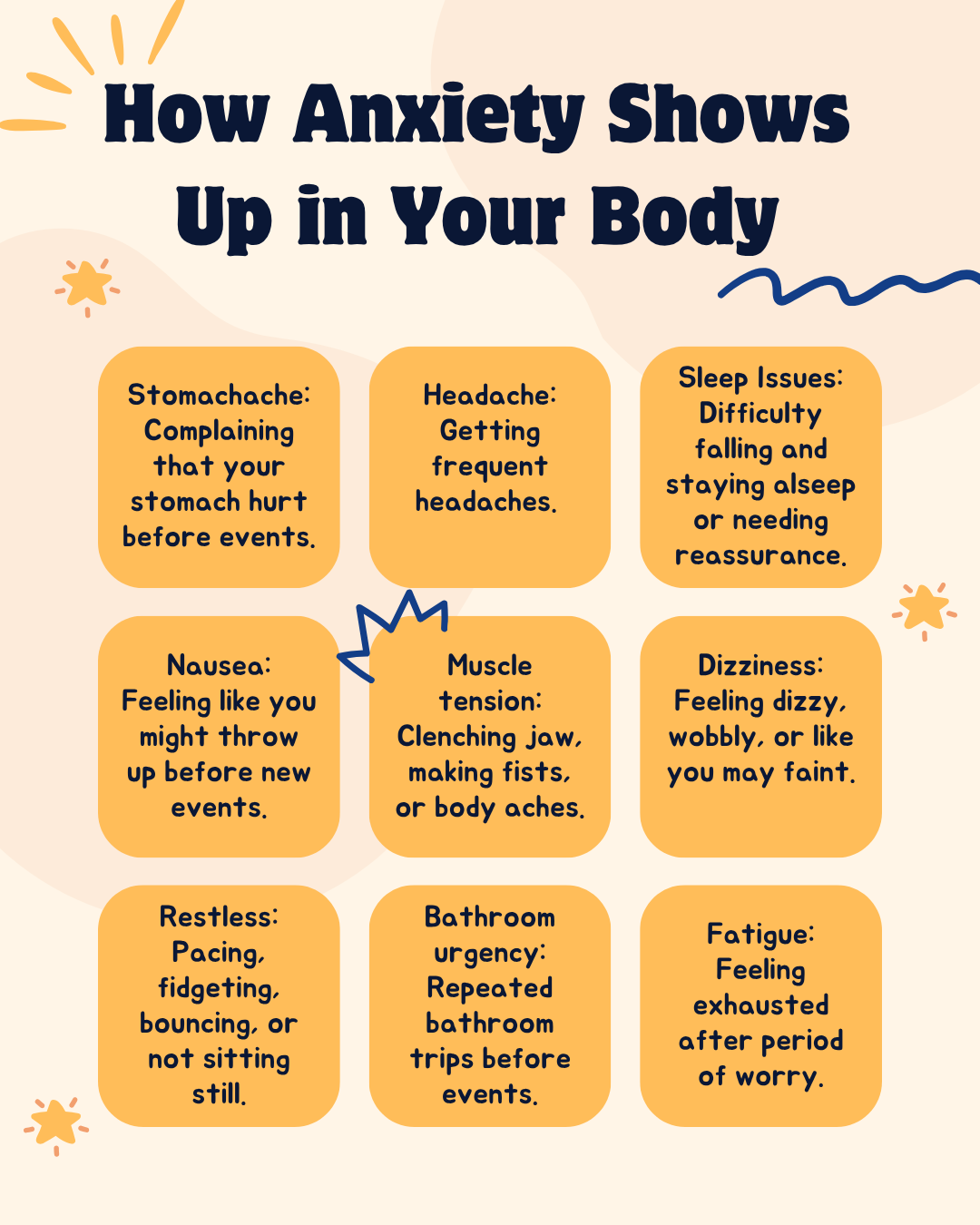
Learning to recognize your body's early signals can help you intervene before anxiety becomes overwhelming.
Instead of suddenly realizing, “I'm completely overwhelmed,” you can begin noticing:
“My shoulders are getting tense.”
“I'm holding my breath.”
“My stomach always starts hurting when I'm worried.”
“I've been clenching my jaw all afternoon.”
That awareness gives you an opportunity to respond differently.
The Anxiety Cycle
Anxiety often follows a predictable pattern:
Trigger → Anxious thought → Physical reaction → Worry → Coping behavior → Temporary relief → More anxiety
Imagine receiving a short text from someone important to you:
“Can we talk later?”
Your brain might immediately say:
They're upset with me.
Your stomach tightens. Your heart starts beating faster. You begin replaying your last conversation.
Maybe you text:
“Are you mad at me?”
They tell you everything is fine, and you temporarily feel better.
But your brain may learn something from that experience:
“When I feel uncertain, I need reassurance to feel safe.”
The next time uncertainty appears, the urge to seek reassurance can become even stronger.
Therapy can help you understand your individual anxiety cycle and learn where you can begin responding differently.
Why Can't I Just Stop Worrying?
Because anxiety isn't usually something you can simply talk yourself out of.
Telling yourself “stop worrying” can sometimes create another problem: now you're anxious and frustrated with yourself for being anxious.
Instead, we work on understanding what your anxiety is trying to accomplish.
Is it trying to prevent you from making a mistake?
Protect you from rejection?
Make absolutely certain something bad won't happen?
Keep everyone around you happy?
Prepare for every possible outcome?
Once we understand the function of the worry, we can begin developing healthier ways of responding to it.
Learning How to Calm an Anxious Body
When your nervous system is activated, sometimes working with your body first is more helpful than immediately trying to reason with your thoughts.
Grounding, breathing, movement, and other coping strategies can help bring your attention back to the present moment.
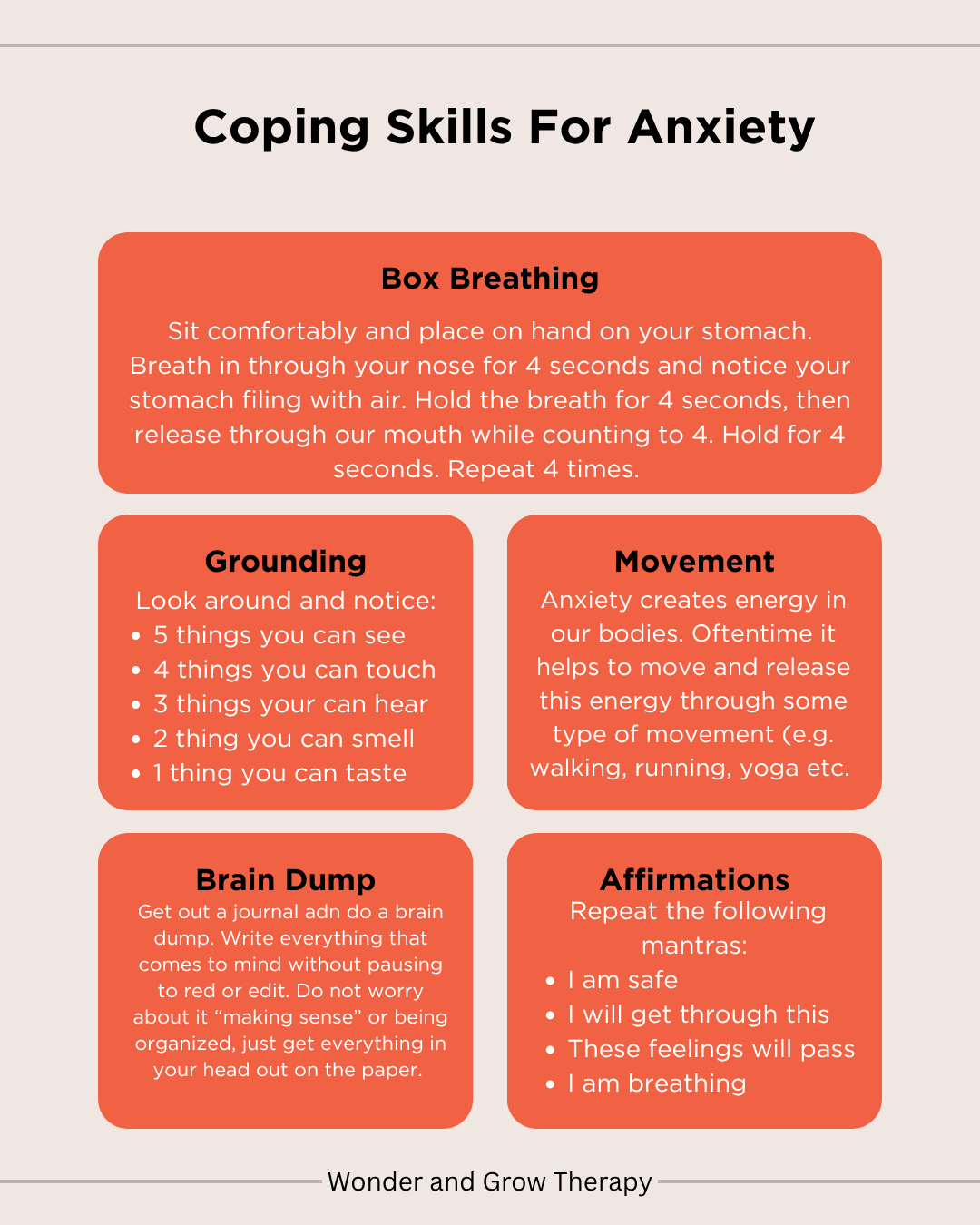
Some strategies we may practice include grounding, paced breathing, movement, mindfulness, journaling, and compassionate coping statements.
The goal isn't necessarily:
“I need to make this anxiety disappear.”
Instead, we can work toward:
“I notice that I'm anxious. I know what is happening in my body, and I have tools to help myself through it.”
That distinction matters.
Anxiety and Overthinking Often Work Together
Anxiety frequently convinces us that more thinking will create more certainty.
So you analyze.
Then analyze your analysis.
Then wonder whether you've missed something.
You may replay conversations, research excessively, ask other people what they think, or delay decisions because you don't feel completely certain.
Eventually, trying to solve the anxiety can become part of what keeps it going.
In therapy, we can work on recognizing the difference between productive problem-solving and anxious rumination.
Sometimes we challenge an anxious thought.
Sometimes we practice accepting uncertainty.
And sometimes we learn to notice the thought without doing anything about it.
If this sounds familiar, you may also find my Therapy for Overthinking & Racing Thoughts page helpful.
Anxiety, Perfectionism & People-Pleasing
For some people, anxiety sounds less like:
“Something terrible is going to happen.”
and more like:
“I can't disappoint anyone.”
“I need to get this right.”
“What if they're upset with me?”
“I should have done better.”
“Everyone else seems to handle this better than I do.”
Perfectionism and people-pleasing can create the illusion of control: if you do everything correctly and keep everyone happy, perhaps you can prevent criticism, rejection, or uncertainty.
But constantly monitoring yourself and everyone around you can become exhausting.
Therapy can help you begin asking a different question—not “How can I make sure nothing goes wrong?” but “How can I trust myself to handle things when they don't go exactly as planned?”
How Therapy Can Help With Anxiety
Therapy isn't about eliminating every anxious thought or never feeling nervous again. Anxiety is a normal human emotion, and sometimes it gives us useful information.
The goal is to prevent anxiety from making your decisions for you.
Depending on your individual needs, I incorporate approaches including Cognitive Behavioral Therapy (CBT), Dialectical Behavior Therapy (DBT), mindfulness, and Exposure and Response Prevention (ERP) when appropriate for OCD.
We may work on understanding your triggers, identifying cognitive distortions, challenging catastrophic thinking, reducing reassurance seeking, tolerating uncertainty, regulating intense emotions, setting healthier boundaries, decreasing people-pleasing, addressing perfectionism, and developing greater confidence in your ability to cope.
Most importantly, we'll work toward helping you understand your particular anxiety, rather than simply giving you a list of coping skills.
You Don't Have to Wait Until Anxiety Takes Over
Maybe you're functioning well on the outside.
You're going to work. Taking care of responsibilities. Showing up for other people. Getting things done.
But inside, your brain rarely stops.
You don't have to wait until anxiety becomes unbearable before asking for help.
Therapy can provide a place to slow down, understand what's keeping you stuck, and develop tools that help you respond to anxiety with more awareness, confidence, and self-compassion.
Wonder and Grow Therapy provides online anxiety therapy for adolescents and adults throughout Florida and Minnesota.